Overrun forming
A fixed-fee project is on pace for 450 hours against 300. It’s week 6, and the invoice goes out in week 12.
A decision and execution layer for firms that sell projects
Petalo tells your firm what it will actually land, why, which move closes the gap, and whether last month’s moves worked. It runs every week on the systems you already use.
Q3 revenue, an example
Q3 is expected at $11.0M against a budget of $12.0M, $1.0M short. The forecast says $12.4M.
$1.0M short of budget
Overrun forming
A fixed-fee project is on pace for 450 hours against 300. It’s week 6, and the invoice goes out in week 12.
Staffing collision
The same architect was committed to two clients for the same two weeks. Nobody caught it until both project managers called.
Bench nobody saw
Two consultants roll off in three weeks with nothing sold behind them.
Invoice gone quiet
A client hasn’t acknowledged the last two invoices. Your finance lead noticed 47 days in.
RFP nobody budgeted for
A strong RFP landed and nobody scoped the hours to answer it. It either gets done poorly or it eats into delivery.
All of it was in your data. Nobody had put it together.
By the time a problem is obvious, it has been visible as a pattern for weeks. Nobody ran the query.
Sales, delivery and staffing each commit on their own. They only collide once the fix is already expensive.
Each week’s close freezes what the firm believes, and why, across pipeline, projects, people and finance.
Petra reads the close and tells you what changed, before Monday.
Leadership takes or declines each suggested move. Every move you take on gets an owner and a due date.
Owners follow through on the moves and their tasks.
When the month closes, each move is scored against what was believed when it was made.
Every Monday the leadership team opens one page: whether you’ll hit the month and the quarter, what changed, where you’re off track, which moves would change the forecast, and whether last month’s moves worked. These screens show a made-up sample firm, and every client, person and number in them is invented.
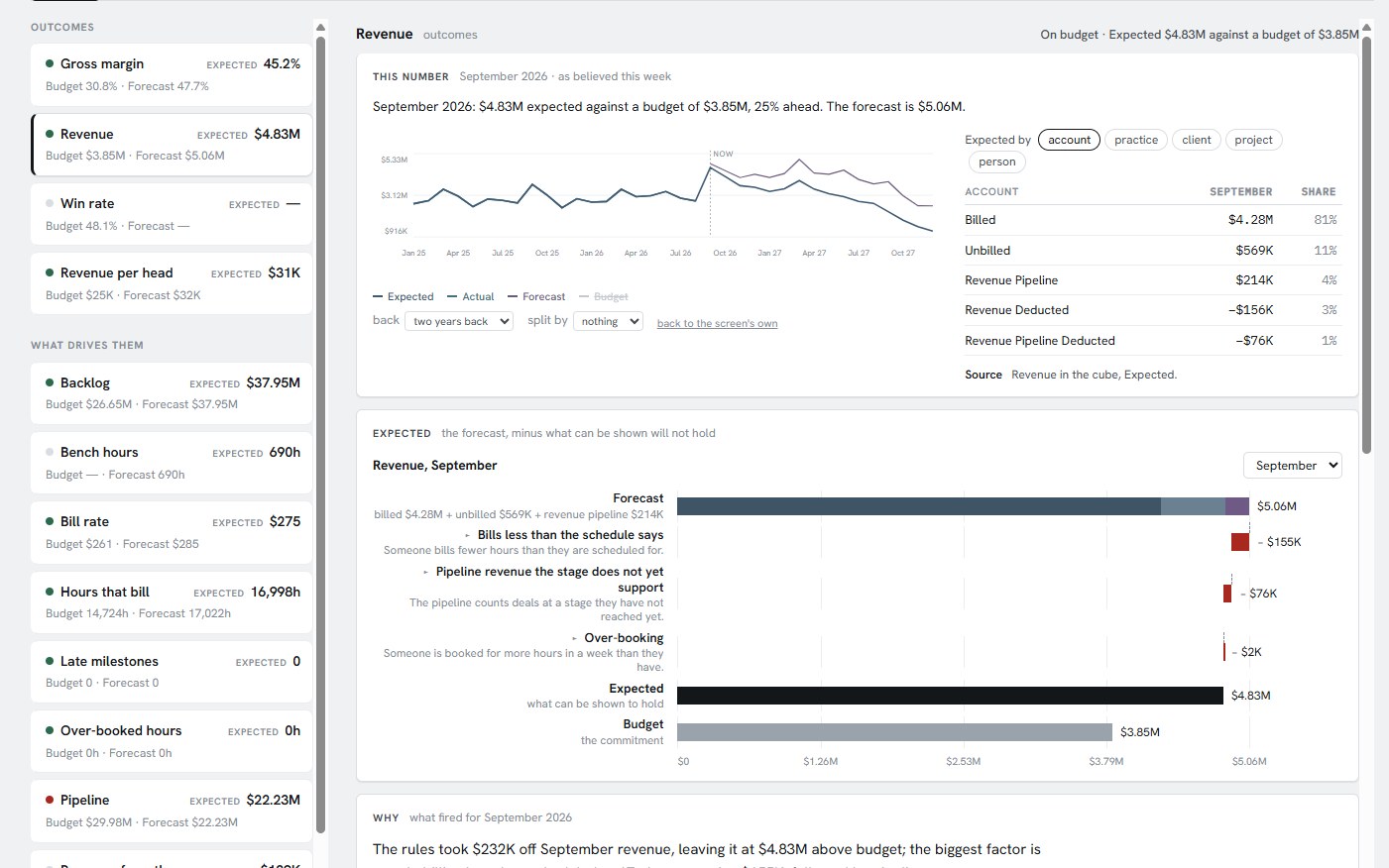
Each outcome against its budget, with Expected beside the forecast and the reasons it sits below it.
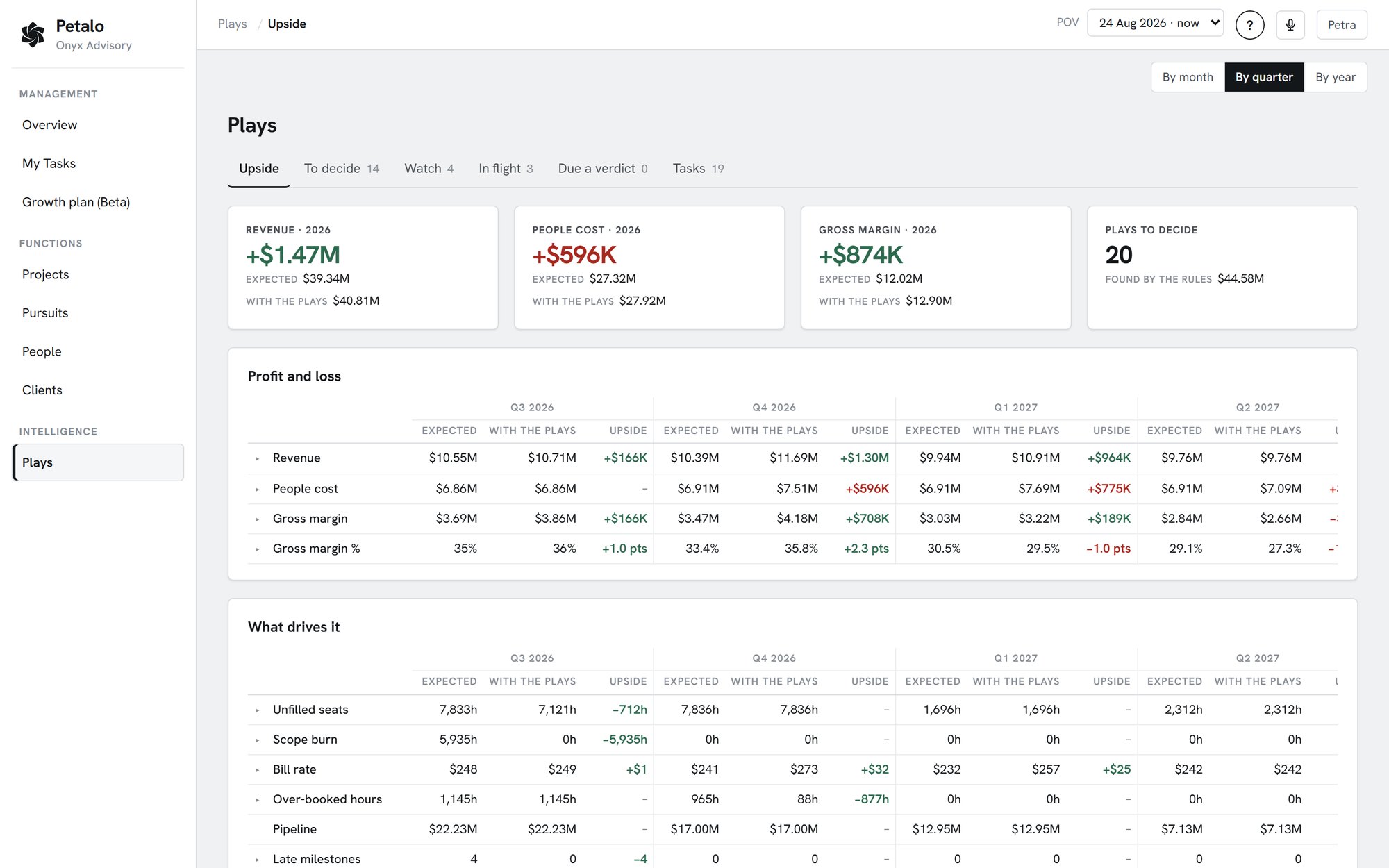
Every play the firm could take, added up through the profit and loss: what Expected says, what it would be with the plays done, and the difference, quarter by quarter.
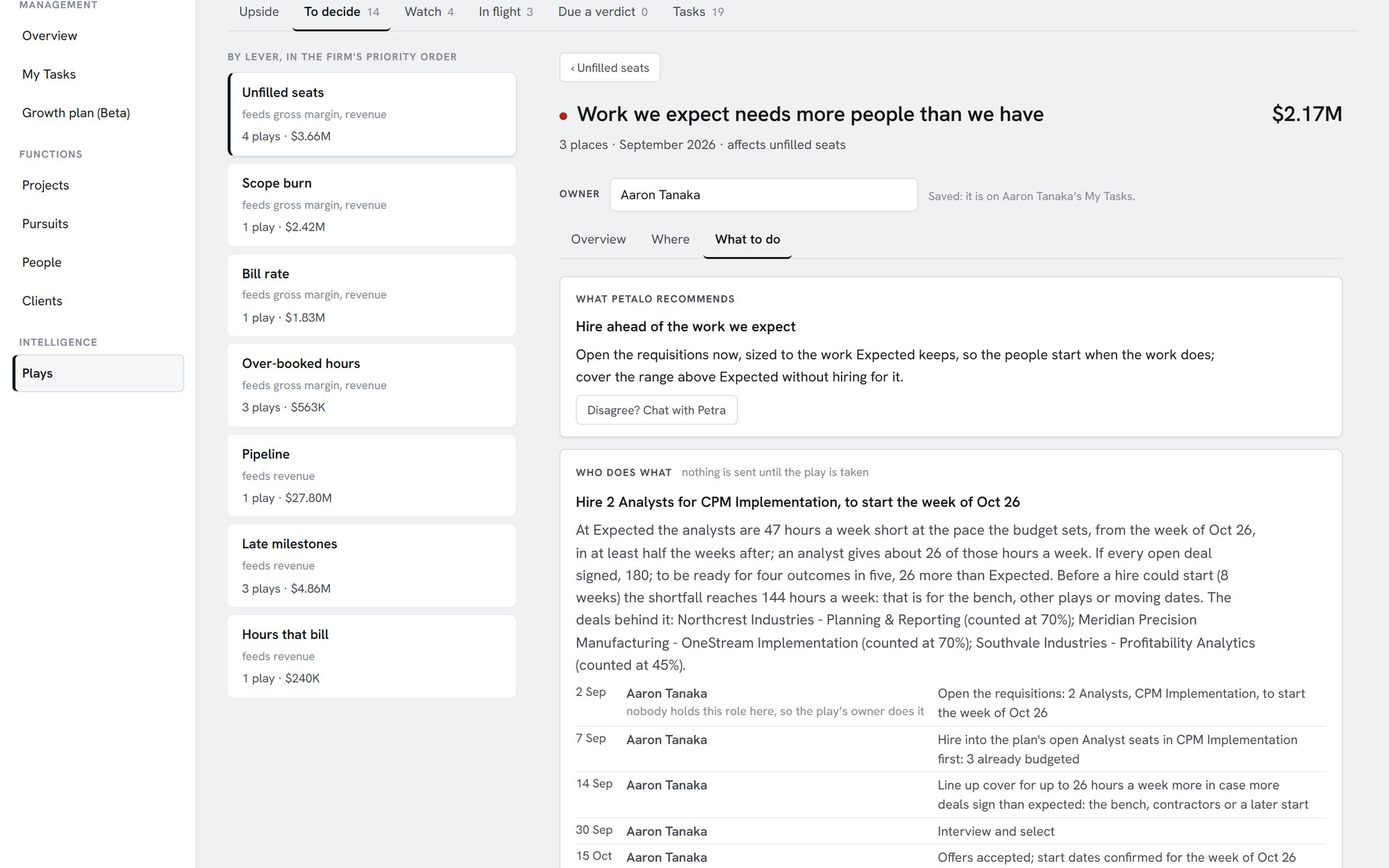
What Petalo recommends, who does what and by when, with an owner on every step. Nothing is sent until the play is taken.
Petra reads each weekly close and tells you what changed before Monday. Ask her about any number, by typing or out loud, and she shows where it came from. The numbers themselves come from Petalo’s engine, so what she tells you matches what’s on the screen.
Q3 revenue, running total
Petra
Probably not. Q3 is expected at $11.0M against a budget of $12.0M. The forecast says $12.4M, but four things take $1.4M off it, and the biggest is won work nobody is staffed on yet ($0.5M). Staffing that work before it starts would close half the gap.
From the Q3 forecast and its four named reasons.
Your firm keeps working exactly as it does today. Petalo runs on the exports you already have.
There’s nothing to install, no new fields and no new data entry, and consultants don’t see a new screen. The controller or ops lead loads the files each week, and the only new habit is a 30-minute review of the Monday page, where each move gets an owner and a due month.
Petalo looks for contradictions between systems: hours against budget, schedule against capacity, pipeline against bench. A contradiction is real even when both numbers are rough. It also compares the firm with itself week over week, so a consistent bias cancels out. The one thing it can’t catch is data that’s wrong the same way everywhere.
Tell us a little about your firm and we’ll set up a 30-minute call. We’ll start with what last year’s miss cost you.